

Important: In a world that prizes relentless grit, we are often judged for giving up or dismissed for our inability to let go, with no understanding of the invisible labor involved in trying one last time. This personal essay titled, I struggle to just let things go, by author Sadia Hakim explores the exhausting cycle of emotional attachment and the realization that some people were never lost, they were simply wearing a mask. Relevant quotes and philosophical takeaways by the author are listed below the text. You can skip directly to that quotes section if you prefer a shorter read.
The rot of being trapped between two impossibilities
“I am awful at letting go, but I am more terrible at letting it be.”
— Sadia Hakim ©️
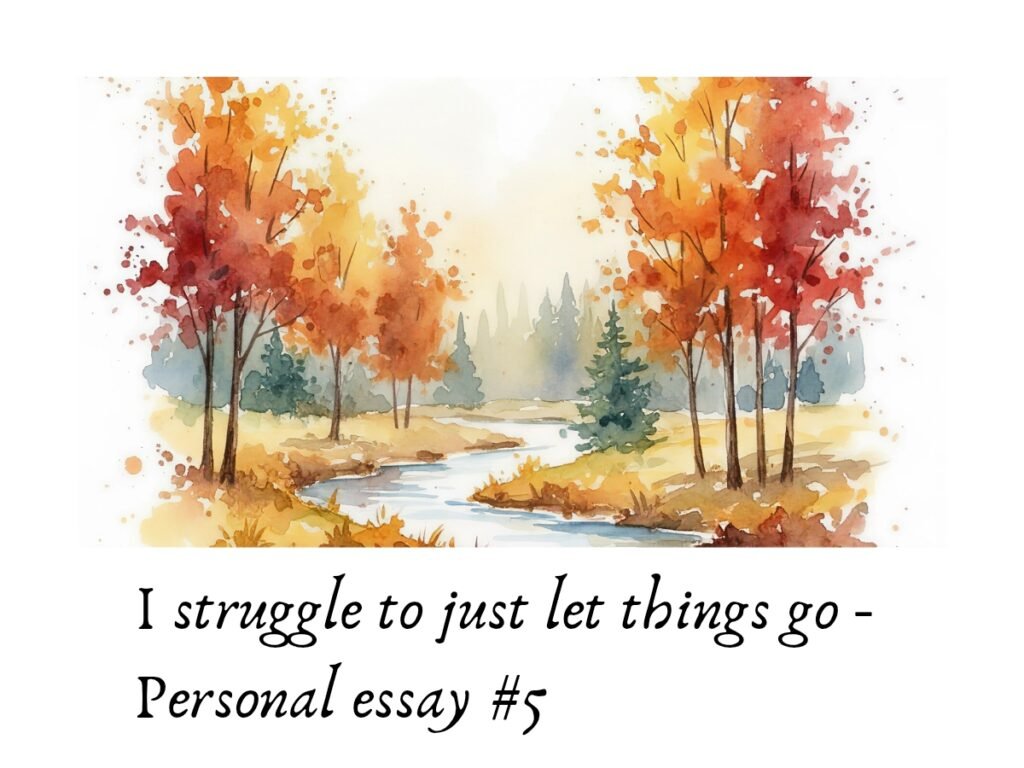
No one talks about this internal rot that occurs when you are trapped between two impossibilities. Letting go feels like a finality, a cold admission that the years you invested were spent on a counterfeit currency. But letting it be, watching the situation exist in its current, decayed state without trying to fix it, is a form of slow motion torture. I have spent a decade of my life in this middle ground, a purgatory where I refused to close the door but could not bear to look at what was left in the room.
To let it be is to accept the status quo. It is to look at a friendship or a connection that has turned sour and decide to let the smell fill the house rather than cleaning it out. I am most humanly terrible at this because my soul demands a logic that the world often refuses to provide.
I wanted to believe that if I just held the line, if I just stayed still enough or kept the same shape, the person I once knew would find their way back and recognize me. But letting it be eventually forces you to realize that you are holding a line for an army that has already defected. You are standing guard over an empty city, terrified that if you leave, you will be the one who officially ended the story.
The heavy tether of a heart that refuses to go cold
I am awful at letting go as long as I am emotionally attached. This is the heavy, suffocating truth of my existence. As long as the tether of my heart is still tied to a person or a memory, I will fight. I will fight to bring it back again. I will fight to bring it back again, and again, and again. I become a servant to the hope that the repetition itself will eventually generate a different result.
I perform the same rituals of care, I offer the same explanations, and I beg for the same shadows to speak, believing that my endurance and persistence is a form of love. But this endurance is a trap. I am a captive to my own cage. As long as that attachment remains, I am incapable of the logic of the exit.
I will stand in the middle of a burning house and argue with the flames because I still love the way the light looks on the walls. I am awful at letting go because I do not know how to be half-hearted. I do not know how to give up while the blood is still warm. I fight until I am breathless, until I am ruined, until I have nothing left to give but the echo of my own refusal to walk away.
And then, the shift happens. It is not a choice I make, it is a mechanical failure of the heart. Once I am emotionally disconnected, I do not care. The transition is as absolute as it is terrifying. The person who was the center of my universe becomes a stranger with a familiar face. And slowly, I forget the face as well. The project that consumed my nights becomes a pile of irrelevant paper.
Once the attachment is severed, the fight vanishes. I do not hate, and I do not resent, I simply cease to exist in that space. I am awful at letting go, but once I am gone, I am a phantom that never returns to haunt the house.
The library of debts we owe to our childhood selves
There is a gut-wrenching agony in childhood bonds that turn into memories while wearing the same faces. You have a vast history together, a library of shared secrets and wonder that you think creates a debt. You think the years they spent being kind to you are a deposit that entitles them to a lifetime of your forgiveness.
You cling to the version of them that existed when you were both innocent, as if that memory can protect you from the person they have become today. In those relationships, the emotional attachment is not a choice; it is a foundation. You see the toxic adult standing in front of you, but you are still talking to the child you once knew. You are trying to bridge a gap that has become a canyon.
I have spent years performing the invisible labor of maintaining these anchors, convinced that if I just reminded them of who we once were, they would remember how to be kind. I fought to bring them back again and again.
But the adult world does not operate on the debts of the playground. I was fighting for a return to a landscape that had been paved over. I was fighting to bring back a version of us that they had already buried. The agony is not in the loss of the friend, but in the realization that you were the only one holding the shovel, trying to dig them out of a grave they chose for themselves.
The terrible weight of walking away from your own labor
Beyond people, there is the struggle of letting go of your own labor. I find it nearly impossible to walk away from the memories of my own effort. I look at the years I spent being the producer of a connection or a project, and I feel that to leave is to admit that my effort was a waste.
It is the terrible feeling of being an investor in a bank that has been robbed. You keep standing at the counter, waiting for the money to reappear, because you cannot accept that the vault is empty. I am awful at letting go of the version of my life I thought I was building. I cling to the experiences and the sacrifices I made as if they are physical objects I can take with me.
But experiences are not furniture, you cannot move them into a new house.
When a situation is ruined, the effort you put into it stays in the ruins. I have had to learn that my energy is not a limited resource that I lost forever, but a ray of light that can be redirected.
Yet, every time I have to abandon a memory or an effort I once cherished, it feels like I am leaving a piece of my own skin behind. I fight to reclaim the effort, to make it mean something, to bring the purpose back again and again, until the emotional disconnection finally sets me free.
The performance of professional endurance
This struggle follows us into the cold halls of academia and the workplace. In these spaces, the world tells us that trying harder is the only virtue. If you fail, it is because you did not stay late enough, work hard enough, or sacrifice enough of your sanity. We are taught that if we just give one last push, the breakthrough will happen. But sometimes, the breakthrough is just the sound of your own soul snapping under the pressure.
I have seen people in academia, myself included, treat a project or a degree like a hostage situation. We are terrified to let it go because of the weight of the years already spent. We stay in toxic professional environments because we have been told that letting it be is a sign of weakness. I was emotionally attached to the idea of excellence, to the dream of being seen and understood through my work.
I fought to prove my worth again and again. I fought to meet the expectations of an unfeeling, corrupt system again and again. I believed that if I just tried harder, if I just gave one more last stand, the logic of the world would finally align with my effort.
But academia and the corporate machine do not have hearts. They are designed to consume the attachment of the passionate and discard the husk when the energy is gone. I was cleaning the desks of an institution that only saw me as a free labour. I was fighting for a seat at a table that was already full of people who had traded their souls for a title.
It took the total collapse of my emotional health to realize that I was not failing the system, the system was failing my humanity. Once that realization hit, once the connection snapped, I walked away without looking back.
The breathless realization that the mask has fallen
The moment the mask falls is not a loud event. It is a quiet, breathless realization that the logic of your connection or your pursuit was entirely one-sided. You realize that they did not lose their way, they simply stopped pretending they wanted to find it. They didn’t return to their kind selves because that kindness was a performance required for the audacity of their younger years. Now that they have what they want, or now that they have become bored with the effort of maintenance, they no longer need the disguise.
It is a dismal state of affairs to realize you have been a guardian for a void. You stayed because you thought you were being human and empathetic. You thought you were showing depth and humanity by staying when things got ugly and messy. But in reality, you were just being blindfolded by your own loyalty.
You were terrifyingly courageous in your refusal to see the truth that some people don’t go through things, they just ARE those things. The mask didn’t slip because of stress, it was taken off because they no longer valued your presence enough to keep it on.
The miracle of knowing when to stop
This is the literacy we are never taught. How do you know when it is time to give up on someone or something? How do you know if this is the one last time that actually matters, or if you are just performing a loop of self-destruction?
The answer lies in the stillness.
If you stop performing, if you stop making the effort for the relationship, stop being the initiator of the conversation, stop prioritizing their silence, and the whole structure collapses, then there was never anything there, but your own effort. If the kindness only exists when you are the one manufacturing it, then you are not in a partnership, you are in a theater making a clown out of your soul and performing for their circus.
You must ask yourself: Am I waiting for a return, or am I waiting for a miracle? A return implies that the destination still exists. A miracle implies that you are asking for the nature of the situation to change fundamentally. You can wait for a traveler to come home, but you cannot wait for a stone to become a bird.
If the situation requires your constant invisible labor to remain visible, then it is time to let go. Giving up is not a failure of character; it is an act of human, emotional, spiritual, and intellectual integrity. You are deciding that your life is not a landfill for someone else’s discarded empathy or a furnace for a job that does not warm you.
The terror of finally walking away
One of the things I have survived is the monstrosity of people and systems that used my softness as a floor to dance. I have survived the audacity of toxic connections that treated my depth as a dumping ground for their distorted mindsets.
When you finally decide to give up, the world might call it a victim mindset. They might say you are awful at letting go. They might say you are a negative thinker and they probably didn’t mean to hurt you. But you know the truth. You aren’t giving up; you are finally choosing to be sane.
The pity I feel now is for the version of me that thought one last time was a virtue, MY VIRTUE! That I am the one who tries, who is never the first to give up on people and places. But now, I am shocked at the way I betrayed myself just to stay in situations that were ruined and false. Letting go is not an act of cowardice. It is an act of philosophical clarity.
It is the moment you decide that your color is too valuable to be spent on someone who is color blind. You realize that the energy you were using to hold their world together can now be used to finally build your own.
The exhaustion of unloved adulthood
In adulthood, we find that people often interact with us based on utility rather than soul. We become a series of functions. We are the person who listens, the person who fixes, the person who shows up. But who is the person who checks on us? When you realize that your adulthood is populated by people and systems that only value the mask you wear for them, the desire to “let it all be” becomes a heavy burden.
I have seen friendships and careers where I was the only one keeping the history or the momentum alive. I was the one bringing up old memories like they were sacred texts or working until my eyes burned, while the other side was already looking for the exit. This is the unloved adulthood: a space where you are surrounded by people who know your name but have no interest in your soul.
To let go of these things is to face a terrifying silence, but it is a clean silence. It is better to be alone than to be the only person trying to breathe life into a room full of mannequins. Once the emotional detachment arrives, you realize that the silence is not empty; it is simply free of the noise of unrequited effort.
Returning to the sanctuary of my own skin
In the end, the awful feeling of letting go is replaced by the logic of peace. You realize that the people, memories, and struggles you were carrying were not yours to bear. You were an architect for a house that no one else wanted to live in. You were cleaning the sinks of a home that was already abandoned. The repetition ends when the attachment dies. You no longer need to bring it back again. You no longer need to fight.
I am still terrible at letting it be, because I still want the world to be kind and honest. I still have the impulse to try one last time because the alternative feels like an admission of defeat. But I am becoming literate in the silence of the exit. I am learning that the most human thing you can do is to stop offering your humanity to those who have traded theirs for a blindfold.
The mask has fallen, and I am finally breathless enough to walk away. I will no longer hold a funeral for those who are still walking. I will let go, not because I have found the courage to leave, but because I have found the logic to stay with myself. My life is not a project for someone elses redemption or a company’s bottom line. It is my own, and it is enough. The silence that follows is not a void, it is the sound of my soul finally returning to its own skin.
— Sadia Hakim ©️
Deep quotes on letting go, toxic friendships, and the courage to give up
“I am awful at letting go as long as I am emotionally attached. I will fight to bring it back again and again and again. Once I am disconnected, I do not care.”
— Sadia Hakim ©️
“Giving up is not a failure of character; it is an act of human integrity.”
— Sadia Hakim ©️
“Some people don’t go through things; they just are those things. The mask fell because they no longer valued your presence enough to keep it on.”
— Sadia Hakim ©️
“Am I waiting for a return, or am I waiting for a miracle? You can wait for a traveler to come home, but you cannot wait for a stone to become a bird.”
— Sadia Hakim ©️
“It is better to be alone than to be the only person trying to breathe life into a room full of mannequins.”
— Sadia Hakim ©️
“Once the attachment is severed, I am a phantom that never returns to haunt the house.”
— Sadia Hakim ©️
“I would rather stand in the clean silence of an exit than continue to be the architect of a bridge that leads nowhere.”
— Sadia Hakim ©️
“Letting go is not an act of cowardice; it is the moment you decide your color is too valuable to be spent on someone who only sees in gray.”
— Sadia Hakim ©️
“We often treat cruelty as a symptom of a temporary illness, but sometimes the person we are waiting for is just a mask they finally decided to take off.”
— Sadia Hakim ©️
“If a situation requires your constant invisible labor just to remain visible, it is no longer a connection; it is a theater.“
— Sadia Hakim ©️
“The adult world does not operate on the debts of the playground; you cannot dig someone out of a grave they chose for themselves.”
— Sadia Hakim ©️
“My life is not a landfill for someone else’s discarded empathy or a furnace for a job that does not warm me.”
— Sadia Hakim ©️
“The most human thing you can do is to stop offering your humanity to those who have traded theirs for a blindfold.”
— Sadia Hakim ©️
“I am not giving up; I am finally choosing to be sane.”
— Sadia Hakim ©️
“The silence that follows a final exit is not a void; it is the sound of a soul finally returning to its own skin.”
— Sadia Hakim ©️
Comment below if you managed to read this whole piece. I would love to read your thoughts.
Read my personal essay about wishful ignorance here. And follow my Instagram to get in touch with me.