
Important: This is a personal essay about the feeling of being “never enough” in a world that is far too demanding. I have included relevant quotes and sayings below the text. You can skip directly to that section if you prefer to avoid a long read.
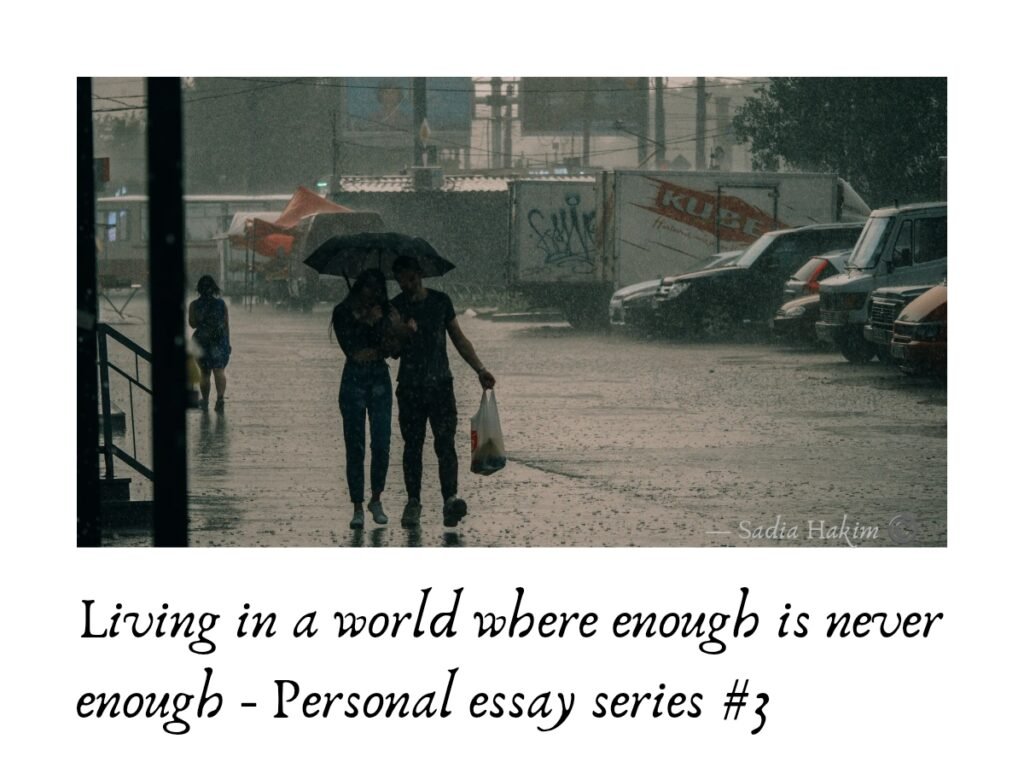
The internal hunger
“I live in a world where enough is never enough.” — Sadia Hakim ©️
It starts as a quiet, internal whisper. You reach a goal, you clear a hurdle, or you finally grasp the thing you spent years chasing, and for a nanosecond, there is peace. But before the ink can dry on your success, the hunger returns. It is a phantom limb of desire that keeps reaching for something just out of sight. I have spent many nights staring at the ceiling, wondering why the milestones that were supposed to be finish lines turned out to be nothing more than starting blocks for a race that has no end.
This is the isolation of the modern soul. We are taught to believe that our dissatisfaction is a personal flaw, a lack of gratitude, or a failure of character. We look at our lives, lives that are often filled with more comfort and access than our ancestors could have dreamed of, and we feel a profound sense of guilt for still wanting.
We live in the constant shadow of the next thing. The next promotion, the next renovation, the next version of ourselves that is finally, supposedly, complete. But that version of us is a ghost. It is a mirage that recedes every time we take a step forward.
The funeral for the three percent missed
I remember scoring 97% on an examination. In any rational world, that is a triumph. It is a testament to sleepless nights and a mind pushed to its limit. But in the world we have built, all I heard was the collective mourning for that missing 3%. There was a funeral held for those thirty marks I lost out of eleven hundred. No one celebrated the massive territory I had conquered. Instead, they stood over the grave of the tiny fragment that slipped through my fingers. All I heard was, “what ifs and only ifs”.
This is the cruelty of academia and the rancid mindset of a society that views a human being as a spreadsheet. We are taught from childhood that perfection is the only acceptable baseline. If you are not perfect, you are failing. I know a classmate of my brother who committed suicide before his high school results even arrived. The pressure was so immense, so suffocating, and so disgustingly inhumane, that he chose to leave the world rather than face the possibility of being not enough.
This is the blood on the hands of our educational systems. We are killing the wonder of the young by demanding they become machines that never drop a single percentage point.
The collective trap
“WE live in a world where enough is never enough.”
This is where the realization shifts from a personal burden to a systemic and systematic tragedy. When I look around, I see that this is not just my struggle. It is the air we breathe. We have built a civilization on the foundation of permanent dissatisfaction. Our economies, our social structures, and our digital landscapes are all designed to ensure that you never feel satisfied.
If you were ever truly satisfied, you would stop consuming. You would stop scrolling. You would stop competing. And if you stopped, the machinery of the world would grind to a halt.
Even our struggles are not our own. I see people comparing their pain as if it were a currency. Even when you go to your parents to share your burdens, the response is often a comparison. They tell you how much harder they had it, or how someone else has it worse. It is a world where even your suffering is not enough to earn you the right to be heard.
We are constantly told to be grateful as a way to silence our legitimate exhaustion. It is a world of surfaces where no one wants to look at the depth of the wound.
The invisible labor of showing up
This cycle of being never enough and having never enough follows us into our homes, our friendships, and our loves. We show up day after day. We do the dishes. We clean the sinks. We prioritize the needs of others until our own identity is a blurred smudge on the wall. And yet, no one cares if we ate. No one asks if we slept or if we need a shoulder to lean on.
In our personal lives, we are expected to be an infinite resource. We are the stillness that everyone else uses to anchor themselves, but no one checks to see if the anchor is breaking under the weight. We live in a world where you can give 100% of your soul to a person or a home, and they will still look at the 0% you kept for yourself and call it selfishness. It is the sheer nerve of the insensitive that leaves me breathless. They take and take, convinced that your enough is an ocean that can never run dry.
There is a demonic and disgusting violence in the domestic sphere. We live in a world that celebrates the grind of the office and the hustle of the entrepreneur, but it remains deathly silent about the labor of the home. We are expected to show up, day after day, performing a thousand tiny miracles that keep a household from collapsing. We do the dishes. We scrub the sinks until they shine. We prioritize the emotional stability of everyone in the room while our own internal world is a storm of exhaustion.
The tragedy is that this labor is only noticed when it is absent. If the sink is full, it is a failure. If the floor is dusty, it is a sign of laziness. But when the house is pristine and the meals are ready, it is treated as the natural state of things. No one cares if you have eaten. No one stops to ask if you have slept or if your soul is gasping for a moment of support. We are treated as appliances that do not require maintenance, only operation.
Humans are abused inside homes and humans are dehumanized inside offices. This is the ultimate satanic inversion of care where the more you give, the less you are seen as a human being who might actually need something in return.
I have seen people compare even these private struggles. If you mention your fatigue, someone is always there to tell you that their day was longer, their sink was fuller, or their sacrifice was greater. It is a competitive martyrdom that prevents us from ever finding a community of rest. We are so busy proving that our not enough is deeper than someone else’s that we miss the opportunity to simply stop and breathe together.
In this world of surfaces, the logic suggests that because you are silent, you are not suffering. Because you continue to show up, you must be fine. But the truth is that our silence is often the only thing left of our dignity or maybe the last mask we wear to appear fine.
The disgusting myth of the finish line
We are sold a version of life that is linear. We are told that we are moving toward a point of arrival. We spend our youth preparing for our middle age, and our middle age preparing for a retirement that many of us will be too tired to enjoy. We treat our present moments as fuel for a future that never actually arrives. This is the great lie of the modern era, the idea that there is a point in the distance where we can finally stop and say, “This is it. I have enough.”
But the finish line is a moving target. As soon as you earn the salary you thought would make you feel secure, the cost of security rises. As soon as you find the love you thought would make you feel whole, the fear of losing it creates a new kind of void. We are living in a loop of more because we have forgotten how to define sufficient. We have traded the beauty of the now for the anxiety of the next.
The painful exhaustion of the soul
The result of this constant pursuit is a pervasive exhaustion. It is not the kind of tiredness that can be cured by a night of sleep. It is a weariness of the soul. It is the feeling of being a vessel that is constantly being emptied as fast as it is being filled. When enough is never enough, the human heart becomes a sieve. No matter how much love, success, or material wealth you pour into it, it remains empty.
We see this exhaustion reflected in the eyes of everyone we meet. We see it in the frantic pace of our cities and the hollowed-out silence of our digital interactions. We are all waiting for permission to stop. We are all waiting for someone to tell us that we have done enough, that we are enough, and that the race is over. But that permission will never come from the outside. The system is not designed to give it. The world is not designed to let you off the hook.
The rebellion of contentment
If enough is never enough is the law of the land, then contentment is an act of rebellion. To look at your life, with all its flaws, its unfinished projects, and its modest successes, and say, “This is enough,” is a radical statement. It is a refusal to play the game. It is a declaration of independence from the rancid mindsets that equate value with volume.
This does not mean we stop growing or dreaming. It means we stop growing out of a sense of lack. It means we start dreaming because of what we can give, not because of what we need to take. It is the transition from a life of acquisition to a life of existence. It is the choice to be sane in a world of insanity, or maybe, a madman in a world of intellectuals.
When enough is never enough
“I live in a world where enough is never enough. WE live in a world where enough is never enough.”
By moving from I to WE, we find the strength to stop. When you realize that everyone else is just as tired as you are, the competition loses its power. The sheer nerve of the uneducated, the courage of the stupid, and the disgust of the disillusioned all point toward the same truth: the world is a construct of our own making. If we decided tomorrow that we had seen enough, done enough, and gained enough, the world would have no choice but to change its shape.
We must learn to cultivate our own stillness in a world that is rushed. We must learn to find our own color in a world that is gray. The horizon will always be there, and it will always be infinite. But the ground beneath your feet is solid. You can choose to stop running. You can choose to look at the person next to you and say, “I am tired of more. Let us find out what it means to have enough.”
“It will never be enough, so choose your enough.”
— Sadia Hakim ©️
Sayings about domestic exhaustion, refusal, and “never enough” by Sadia Hakim
“No matter what and how much you do for some people, it’s never, never, never enough.”
— Sadia Hakim ©️
“Why? Why? Why? Why am I never enough? Why am I always just a little bit, just a fraction below enough?”
— Sadia Hakim ©️
“It is the sheer nerve of the insensitive that leaves me breathless. They take and take, convinced that your enough is an ocean that can never run dry.”
— Sadia Hakim ©️
“We have traded the beauty of the now for the anxiety of the next.”
— Sadia Hakim ©️
“We must learn to set our own table and feed our own hunger, for a world that does not ask if we have eaten, will never give us permission to stop.”
— Sadia Hakim ©️
“I scrub the sink until it reflects a person I no longer recognize, waiting for a thank you that is always lost in the noise of someone else’s appetite.”
— Sadia Hakim ©️
“There is a satanic geometry in a house where your presence is only measured by the depth of your silence and the cleanliness of your chores.”
— Sadia Hakim ©️
“I am the anchor keeping the ship steady, but the crew is too busy complaining about the wind to notice I am drowning beneath the hull.”
— Sadia Hakim ©️
“My heart has become a sieve in a world that only knows how to pour salt; no matter how much I achieve, the sting is the only thing that stays.”
— Sadia Hakim ©️
“I have spent my life preparing for a future that treats my present like a pile of scrap metal for a machine I did not build.”
— Sadia Hakim ©️
“The most radical and sensible thing I ever did was stop running toward a finish line that was actually a cliff edge disguised as an upgrade.”
— Sadia Hakim ©️
“If the world refuses to ask if I have eaten, I will stop offering my soul as the main course for a table that has no seat for me.”
— Sadia Hakim ©️
“I live in a world where enough is never enough. We live in a world where enough is never enough”.
— Sadia Hakim ©️
Read my personal essays here. Become a part of my beautiful readers community of 35k+ Seyferts across social media and introduce yourself below my introduction post. We love finding new aliens and fellow humans from Alpha Centauri there.